
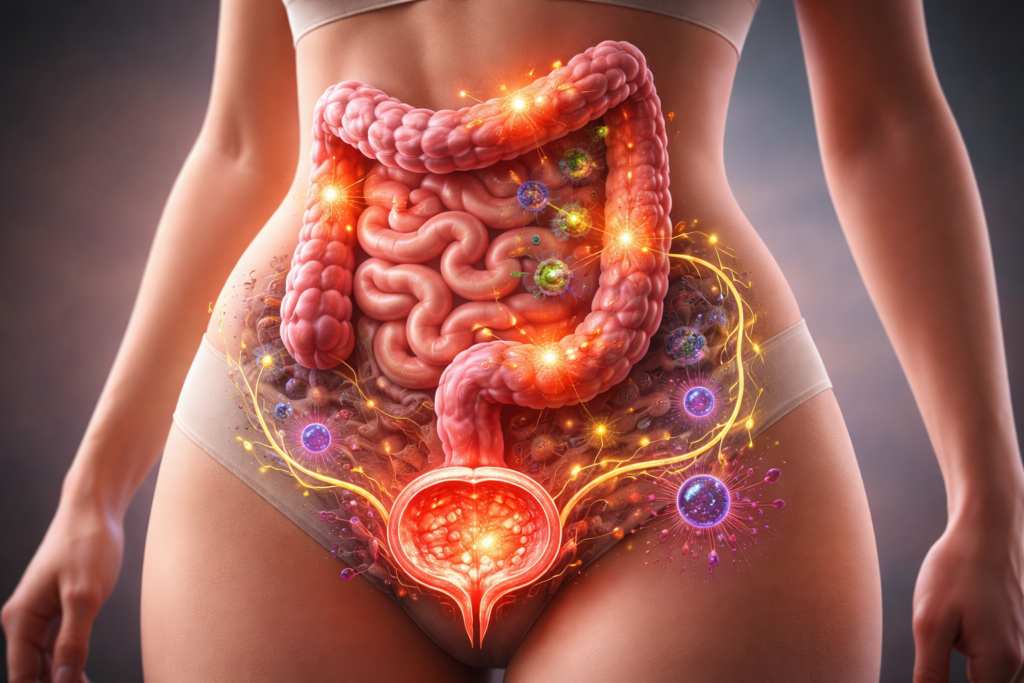
“Everything looks normal.”
If you’ve been living with interstitial cystitis (IC) or bladder pain syndrome (BPS), chances are you’ve heard some version of that sentence more times than you can count. Your urine tests are negative. Your scans don’t show anything alarming. There’s no obvious infection, no clear structural problem, nothing that neatly explains why your bladder feels like it’s constantly on edge—burning, pressurized, urgent, unpredictable.
And yet… your symptoms are very real.
You feel them when your bladder fills—sometimes even a little. You feel them after certain foods, during stressful days, or seemingly out of nowhere. You feel them in the middle of the night, in the middle of a conversation, in the middle of trying to live your life.
So what’s actually going on?
What if the issue isn’t that nothing is wrong…
but that something deeper is happening that standard testing doesn’t measure?
A Different Way to Look at IC
For decades, IC was often approached as a bladder condition that must be caused by infection, injury, or visible inflammation. And while those factors can absolutely play a role for some people, they don’t explain the full picture—especially for the many patients whose tests come back “normal” despite severe, ongoing symptoms.
This is where a more modern understanding begins to shift the conversation.
Instead of asking:
“What is damaging the bladder?”
We start asking:
“Why is the bladder reacting so strongly?”
That subtle shift changes everything.
Because for many people with IC/BPS, the core issue may not be damage—it may be sensitivity.
More specifically:
Visceral hypersensitivity.
What Is Visceral Hypersensitivity? (In Plain English)
Let’s strip away the medical jargon for a moment.
“Visceral” simply refers to your internal organs—like your bladder, gut, and pelvic structures.
“Hypersensitivity” means increased sensitivity.
Put them together, and you get:
Visceral hypersensitivity = internal organs becoming overly sensitive to normal sensations.
Imagine turning up the volume on a speaker—not because the music changed, but because the dial did.
Now apply that to your body.
Your bladder fills (which is normal)…
but your nervous system interprets that as pressure, urgency, or even pain.
You eat a food (which might be harmless to someone else)…
but your body reacts with burning or irritation.
You experience stress…
and suddenly your symptoms spike.
Nothing “dramatic” has happened at the structural level.
But the experience is intense, real, and disruptive.
That’s the hallmark of hypersensitivity.
Why This Concept Matters So Much
If you’ve ever felt dismissed, confused, or even doubted your own symptoms because tests came back normal, this framework can be incredibly validating.
Because it explains something that traditional models often miss:
You can have severe symptoms without obvious damage or infection.
And that doesn’t make your condition any less real.
In fact, this same concept—visceral hypersensitivity—is already well established in other conditions, especially irritable bowel syndrome (IBS).
People with IBS can experience extreme pain, bloating, and urgency… even when scans and labs don’t show anything “wrong.”
Sound familiar?
That’s not a coincidence.
Because the bladder and the gut are more connected than most people realize.
The Missing Link: Your Gut, Your Bladder, and Your Nervous System
Here’s where things get really interesting—and where many people finally start connecting the dots.
Your bladder doesn’t exist in isolation.
It’s part of a larger, interconnected system that includes:
- Your gut
- Your nervous system
- Your immune system
- Your stress response
These systems are constantly communicating with each other.
Think of it like a neighborhood of houses connected by shared wiring. If one house has faulty wiring and keeps sending out sparks, the neighboring houses can start experiencing issues too—even if nothing is “wrong” inside them directly.
In your body, this is often referred to as:
The gut–bladder axis
or
cross-sensitization
In simple terms:
- The gut and bladder share nerve pathways
- They communicate through the spinal cord and brain
- They influence each other through immune and chemical signaling
So when something is off in the gut—like inflammation, dysbiosis (microbial imbalance), or food sensitivities—it can “spill over” and increase sensitivity in the bladder.
That’s one reason why IC and IBS so often show up together.
And it’s also why addressing bladder symptoms alone often isn’t enough.
When the System Gets Stuck in “High Alert”
Now layer in another piece: stress.
Not just emotional stress—but biological stress.
When your body perceives stress, it activates a cascade of signals:
- Your nervous system shifts into fight-or-flight mode
- Stress hormones are released
- Immune activity changes
- Sensory nerves become more reactive
Over time, this can lower the threshold at which your body reacts.
So instead of needing a strong trigger to cause symptoms, even small inputs—like mild bladder filling or certain foods—can feel overwhelming.
It’s like a smoke alarm that goes off not just when there’s a fire…
but when you make toast.
Annoying? Yes.
But also very real.
Enter Mast Cells and Histamine
Now let’s bring in another key player: mast cells.
These are immune cells that sit close to nerves and tissues—especially in places like the bladder and gut. Think of them as tiny “alarm systems” in your body.
When triggered, mast cells release substances like:
- Histamine
- Cytokines
- Proteases
These chemicals are designed to protect you.
But when they become overactive—or are triggered too easily—they can:
- Increase inflammation
- Activate pain pathways
- Make nerves more sensitive
- Increase bladder permeability
In other words:
They can turn up the intensity of your symptoms.
Histamine, in particular, is known for causing:
- Burning sensations
- Urgency
- Irritation
And for many IC patients, this becomes a major part of the puzzle.
Putting It All Together (The IC Loop)
So what does this actually look like in the body?
Let’s connect the dots in a simple, step-by-step way:
- The gut becomes imbalanced or inflamed
- The intestinal barrier weakens (“leaky gut”)
- Immune signals and microbial byproducts increase
- Pelvic nerves become more excitable
- Stress amplifies the entire system
- Mast cells are triggered
- Histamine and inflammatory mediators are released
- The bladder becomes hypersensitive
And now…
Normal sensations feel anything but normal.
💬 “So… Is This All in My Head?”
This is one of the most harmful misconceptions people with IC face.
Let’s be very clear:
This is not “in your head.”
But it does involve your nervous system.
There’s a big difference.
Your symptoms are rooted in real, biological processes involving:
- Nerve signaling
- Immune activation
- Chemical mediators
- Organ cross-talk
Just because something doesn’t show up on a standard test doesn’t mean it isn’t happening.
It simply means we need a better model to understand it.
A New Way Forward
When you start to see IC through the lens of visceral hypersensitivity, something shifts.
Instead of chasing a single cause, you begin to understand the system.
Instead of asking, “What’s wrong with my bladder?”
you start asking, “What’s driving my body to be so reactive?”
And that opens the door to a more comprehensive, compassionate, and effective approach to healing.
Because now, the focus isn’t just on the bladder.
It’s on:
- Calming the nervous system
- Supporting gut health
- Reducing immune triggers
- Stabilizing mast cells
- Lowering overall inflammation
In other words:
Turning the volume back down.
What You’ll Learn in This Blog
In the sections ahead, we’re going to break this down step by step:
- What visceral hypersensitivity really means—and how it affects your bladder
- Why your gut may be playing a bigger role than you think
- How stress biologically amplifies your symptoms
- The powerful role of mast cells and histamine
- And most importantly—what this all means for healing
Because understanding your body isn’t just empowering…
It’s the first step toward finally feeling like you have control again.
Chapter 1: What Is Visceral Hypersensitivity (And Why Your Bladder Feels So Reactive)
Let’s start with the foundation—because once you truly understand this, everything else in IC begins to make more sense.
If your bladder feels unpredictable, overly sensitive, or constantly “on edge,” it’s easy to assume something must be damaged, infected, or structurally wrong.
But what if the issue isn’t damage…
What if it’s how your body is interpreting signals?
This is where visceral hypersensitivity becomes one of the most important—and empowering—concepts you can understand.
1.1 What “Hypersensitivity” Really Means
Let’s go back to basics.
Your body is constantly receiving information from your internal organs. Your bladder, for example, sends signals to your brain as it fills—this is completely normal. At a certain point, your brain registers, “Hey, it’s time to go.”
But here’s the key:
In a healthy system, those signals are proportional.
A small amount of bladder filling = mild sensation
A full bladder = stronger urge
Simple. Predictable. Manageable.
Now imagine this instead:
A small amount of filling = urgency
Moderate filling = pressure or discomfort
Normal sensations = burning or pain
Nothing structurally changed in the bladder itself.
But the interpretation of the signal did.
That’s hypersensitivity.
🎚️ The “Volume Knob” Analogy
Think of your nervous system like a sound system.
- The bladder sends a signal (the music 🎵)
- Your nervous system controls how loud it plays (the volume knob 🔊)
In IC with visceral hypersensitivity:
The volume knob is turned way up.
So even quiet signals feel loud, intense, and impossible to ignore.
This is why:
- A small amount of urine can feel urgent
- Mild irritation can feel like burning
- Normal pressure can feel painful
And perhaps most frustrating of all…
It feels inconsistent.
Some days the volume is slightly lower. Other days, it’s blaring.
Sensation vs. Damage
This distinction is critical.
We’re often taught:
Pain = damage
But in many chronic conditions—including IC—that equation doesn’t always hold true.
Instead:
Pain = perception + sensitivity
You can have:
- High damage with low pain (think: people who don’t feel injuries right away)
- Low damage with high pain (think: hypersensitivity conditions)
This doesn’t make the pain any less real.
It just means the driver of the pain is different.
1.2 How the Nervous System Processes Bladder Signals
To understand why the bladder becomes so reactive, we need to zoom out and look at the communication pathway.
Because your bladder doesn’t act alone—it’s constantly talking to your brain.
The Bladder–Brain Conversation
Here’s the simplified pathway:
- The bladder stretches as it fills
- Sensory nerves detect that stretch
- Signals travel through pelvic nerves
- They reach the spinal cord
- Then they’re processed by the brain
At each step, your body decides:
“Is this important? Should I react?”
In a balanced system, this process is smooth and well-regulated.
But in hypersensitivity?
That filtering system breaks down.
When Signals Get Amplified
In IC, several things can happen along this pathway:
- Sensory nerves become more excitable
- The spinal cord amplifies incoming signals
- The brain becomes more alert to bladder input
- The threshold for “urgency” or “pain” lowers
So instead of filtering out minor sensations…
The system flags everything as important.
It’s like getting a phone notification for every single background app—not just the urgent ones.
Over time, this creates a state of:
- Hyper-awareness
- Hyper-reactivity
- Hyper-discomfort
A System That Learns Sensitivity
Here’s something many people don’t realize:
The nervous system can learn sensitivity.
If signals are repeatedly amplified—due to inflammation, stress, or irritation—the system adapts.
But instead of calming down…
It becomes more efficient at detecting and reacting.
This is called neuroplasticity.
And while it’s often talked about as a positive thing (like learning a new skill), it can also work in the opposite direction:
The body can “learn” pain.
1.3 Why Tests Can Be Normal (But Symptoms Are Severe)
This is one of the most confusing—and invalidating—parts of IC.
You go to the doctor.
You run the tests.
And everything comes back… normal.
No infection.
No major abnormalities.
No clear explanation.
So what gives?
The Limits of Standard Testing
Most conventional tests are designed to detect:
- Infection
- Structural damage
- Obvious inflammation
But they don’t measure:
- Nerve sensitivity
- Signal amplification
- Subtle immune activation
- Neurochemical changes
So when your results come back normal, what it really means is:
“We didn’t find structural damage.”
Not:
“Nothing is happening.”
Functional vs. Structural Conditions
IC falls into a category often referred to as functional disorders.
This means:
- The structure may appear normal
- But function is altered
A helpful comparison is IBS.
People with IBS can experience:
- Severe abdominal pain
- Urgency
- Bloating
But colonoscopies often look normal.
Why?
Because the issue isn’t visible damage.
It’s how the system is functioning.
The same applies to the bladder.
💬 Why This Matters Emotionally
If you’ve ever been told:
- “Everything looks fine”
- “Maybe it’s just stress”
- “We can’t find anything wrong”
It can feel dismissive.
But understanding hypersensitivity reframes this:
Your body is reacting strongly because the signaling system is altered—not because your symptoms are imagined.
1.4 Central vs. Peripheral Sensitization
Now let’s take this one step deeper.
Not all hypersensitivity happens in the same place.
There are two main levels:
Peripheral Sensitization (Local Level)
This happens in the bladder itself.
- Nerves in the bladder become more sensitive
- Inflammation lowers activation thresholds
- Mast cells and immune signals increase reactivity
Result:
The bladder becomes easier to trigger
Even mild stimuli can cause strong signals.
Central Sensitization (Brain & Spinal Cord Level)
This happens in the central nervous system.
- The spinal cord amplifies incoming signals
- The brain becomes hyper-aware of bladder input
- Pain processing pathways become more active
Result:
The entire system becomes more reactive
Even if the bladder itself isn’t highly inflamed.
The Feedback Loop
Here’s where things get tricky:
These two systems reinforce each other.
- Bladder irritation increases nerve signaling
- Increased signaling trains the brain to amplify
- Amplification increases perception of symptoms
- Symptoms create more stress and vigilance
And the loop continues.
Why Symptoms Persist
Even if the original trigger (like an infection or irritation) is gone…
The system may stay sensitized.
That’s why many people experience:
- Lingering symptoms
- Flare-ups without clear cause
- Increased sensitivity over time
The body has essentially become too good at reacting.
1.5 Why This Matters for IC/BPS Patients
So why does all of this actually matter?
Because understanding the mechanism changes everything.
💡 It Validates Your Experience
First and foremost:
Your symptoms are real.
They are rooted in:
- Nervous system signaling
- Immune activity
- Biological processes
Not imagination.
Not exaggeration.
Not “just in your head.”
It Shifts the Healing Approach
If IC were only an infection problem, the solution would be simple:
→ Kill the bacteria
But if the issue is hypersensitivity?
Then the goal becomes:
- Calming the nervous system
- Reducing triggers
- Supporting immune balance
- Addressing underlying drivers (like gut health and stress)
This is a completely different strategy.
It Opens New Doors
Instead of feeling stuck or confused, you now have a framework.
A way to understand:
- Why your symptoms fluctuate
- Why triggers seem inconsistent
- Why conventional treatments may not fully work
And most importantly…
A path forward that actually makes sense.
A New Perspective
What if your bladder isn’t broken…
What if it’s overprotective?
What if your body isn’t failing you…
What if it’s trying—just a little too hard—to keep you safe?
When you start to see IC through this lens, something shifts.
Not just in understanding…
But in possibility.
Because if sensitivity can increase…
It can also be calmed, retrained, and supported.
Chapter 2: The Gut–Bladder Connection (Why Your Gut May Be Driving Your Bladder Symptoms)
If Chapter 1 helped you understand what visceral hypersensitivity is, this chapter answers a deeper—and often surprising—question:
Why does your bladder react so strongly in the first place?
Because for many people with IC/BPS, the answer doesn’t start in the bladder…
It starts in the gut.
2.1 The Gut–Bladder Axis Explained
At first glance, your gut and your bladder seem like completely separate systems.
One digests food.
The other stores urine.
But beneath the surface, they are deeply connected.
Shared Wiring: The Pelvic Communication Network
Your gut and bladder are both located in the pelvis—and they share:
- Nerve pathways
- Spinal cord processing centers
- Immune signaling networks
This means they are constantly “talking” to each other.
Not in words, of course—but through electrical and chemical signals.
Cross-Sensitization: When One Organ Affects Another
There’s a concept called cross-sensitization.
It means:
When one organ becomes irritated or inflamed, it can increase sensitivity in a nearby organ.
Think of it like two neighbors sharing the same alarm system.
If one house keeps triggering alarms…
The other house becomes more sensitive to noise too.
In your body:
- An irritated gut can increase bladder sensitivity
- A sensitive bladder can amplify gut discomfort
This is one reason why so many people experience both:
- IC
- IBS
They’re not separate problems.
They’re part of the same sensitized network.
🧠 The Gut–Bladder–Brain Loop
Now add the brain into the equation.
Signals travel:
- From gut → brain
- From bladder → brain
- From brain → back to both
This creates a loop.
So if one part of the system becomes dysregulated…
The entire loop can become more reactive.
2.2 How Dysbiosis Triggers Bladder Sensitivity
Now let’s zoom into the gut itself.
Because not all gut environments are created equal.
What Is Dysbiosis?
Your gut is home to trillions of bacteria.
In a healthy state:
- Beneficial bacteria help regulate inflammation
- They produce helpful compounds
- They support your immune system
But when this balance shifts…
Dysbiosis occurs.
This means:
- Too many harmful microbes
- Not enough beneficial ones
- Reduced diversity
The Problem with an Imbalanced Gut
When dysbiosis develops, several things can happen:
- Increased production of inflammatory compounds
- Release of endotoxins (like LPS)
- Altered metabolites that affect nerve signaling
These substances don’t just stay in the gut.
They can:
- Enter circulation
- Interact with immune cells
- Influence the nervous system
How This Affects the Bladder
Here’s where it connects back to IC:
These gut-derived signals can:
- Activate immune responses in the pelvic region
- Increase nerve sensitivity
- Lower the threshold for pain and urgency
So even if your bladder isn’t directly “injured”…
It can still become more reactive because of what’s happening in your gut.
The Nervous System Connection
Remember from Chapter 1:
The nervous system learns patterns.
If it’s constantly receiving inflammatory or “danger” signals from the gut…
It may start interpreting bladder signals as more threatening too.
2.3 Leaky Gut → Leaky Bladder?
Let’s talk about something that sounds a little strange—but is incredibly important.
Barrier function.
Your Gut Barrier: The First Line of Defense
Your intestinal lining is designed to:
- Let nutrients pass through
- Keep harmful substances out
It acts like a selective filter.
But when it becomes compromised…
It becomes more permeable.
This is often referred to as “leaky gut.”
What Happens When the Barrier Breaks Down
When the gut barrier weakens:
- Bacterial fragments can enter the bloodstream
- Immune activation increases
- Inflammation rises systemically
This creates a state where the body is more reactive overall.
What About the Bladder?
Interestingly, similar concepts apply to the bladder lining.
In IC, research suggests:
- The protective bladder lining may be compromised
- Irritants in urine can more easily interact with underlying tissue
- Nerves become more exposed and reactive
So you get:
A double vulnerability
→ Gut barrier compromised
→ Bladder barrier compromised
And both are feeding into hypersensitivity.
The Spillover Effect
When gut permeability increases:
- More inflammatory signals circulate
- The immune system becomes more activated
- Mast cells are more easily triggered
All of which can:
Increase bladder sensitivity and symptom intensity
2.4 Why IC and IBS Often Show Up Together
Have you ever noticed patterns like:
- Bladder symptoms flare when your gut is off
- Bloating or constipation worsens urgency
- Food reactions trigger both gut and bladder symptoms
You’re not imagining that connection.
The Overlap Is Real
Clinically, there’s a significant overlap between:
- IC/BPS
- IBS
- Other chronic pelvic pain conditions
This isn’t coincidence.
Shared Mechanisms
These conditions share:
- Visceral hypersensitivity
- Nervous system dysregulation
- Immune activation
- Altered microbiome
So instead of thinking:
“I have two separate problems”
It may be more accurate to think:
“I have one interconnected system that’s become sensitized”
One System, Multiple Symptoms
The gut and bladder are like two instruments in the same orchestra.
If one is out of tune…
The entire performance feels off.
2.5 Food Triggers and Gut Signaling
Now let’s talk about something many IC patients notice quickly:
Certain foods make symptoms worse.
But why?
It’s Not Just About the Bladder
Traditionally, food triggers were thought to:
- Directly irritate the bladder through urine
And while that can play a role…
It’s not the whole story.
The Gut-Mediated Response
Foods can also:
- Alter gut bacteria
- Trigger immune responses
- Increase histamine release
- Affect fermentation and gas production
All of which can:
Increase systemic and pelvic sensitivity
Common Trigger Categories
While triggers vary from person to person, some common patterns include:
- High-histamine foods
- Fermented foods
- Highly acidic foods
- Processed foods
- Foods that disrupt gut balance
But here’s the key:
It’s not about the food alone—it’s about how your body responds to it.
Why Reactions Feel Inconsistent
Have you ever reacted to a food one day—but tolerated it the next?
That’s because your baseline sensitivity changes.
Factors like:
- Stress
- Gut health
- Hormonal shifts
- Sleep
All influence how reactive your system is.
So the same food can feel:
- Fine one day
- Triggering the next
The Bigger Picture
Food isn’t the enemy.
It’s a messenger.
It reveals:
- Where your system is sensitive
- How reactive your body is
- What might need support
Bringing It All Together
So what does this mean for you?
It means your bladder symptoms may not be coming from your bladder alone.
They may be influenced by:
- Your gut microbiome
- Your immune system
- Your nervous system
- Your diet
All working together—for better or worse.
A New Way to Think About Symptoms
Instead of asking:
“What did my bladder do wrong?”
Try asking:
“What signals is my body responding to right now?”
Because often…
The bladder is reacting to a bigger conversation happening inside your body.
And when you start to understand that conversation…
You gain the power to change it.
Chapter 3: How Stress Turns the Volume Up on Your Bladder
If the gut helps create the sensitivity, stress often turns up the intensity.
And not in a vague, emotional way—but in a very real, biological way.
3.1 Stress Is Biological, Not “Just Emotional”
When you experience stress, your body doesn’t just “feel” it—it responds.
Your system shifts into fight-or-flight mode, triggering:
- Stress hormones
- Nervous system activation
- Immune changes
This is helpful short-term.
But when stress becomes chronic?
The system stays switched on.
3.2 The Autonomic Nervous System Imbalance
Your body runs on two main modes:
- Sympathetic (fight-or-flight) → alert, reactive
- Parasympathetic (rest-and-digest) → calm, regulated
In many people with IC:
The body gets stuck in a sympathetic-dominant state.
This leads to:
- Increased muscle tension
- Heightened nerve sensitivity
- Reduced ability to “settle”
Your bladder doesn’t get a break.
3.3 Stress Chemicals and Sensitivity
Stress triggers the release of signaling molecules like:
- CRH (corticotropin-releasing hormone)
- Cortisol
These can:
- Increase inflammation
- Activate mast cells
- Make sensory nerves more reactive
So your threshold for symptoms drops.
3.4 What This Looks Like in Real Life
You might notice:
- More urgency during stressful days
- Flares during emotional overwhelm
- Symptoms worsening with poor sleep
This isn’t coincidence.
It’s your nervous system amplifying signals.
3.5 The Stress–Bladder Feedback Loop
Here’s where it becomes a cycle:
- Stress increases symptoms
- Symptoms create more stress
- The system becomes even more reactive
Over time, your body learns:
“Bladder sensations = danger”
And reacts faster each time.
🌱 Key Takeaway
Stress doesn’t cause IC—but it lowers the threshold at which your body reacts.
Think of it as:
Pouring fuel on an already sensitive system.
Chapter 4: Mast Cells, Histamine, and Why Symptoms Flare So Intensely
If stress turns up the volume…
Mast cells and histamine often explain why symptoms feel sharp, burning, and intense.
4.1 What Are Mast Cells?
Mast cells are immune cells that act like early warning systems.
They sit:
- Near nerves
- In the bladder lining
- In the gut
Ready to respond to threats.
4.2 What Triggers Them?
Mast cells can be activated by:
- Stress
- Gut-derived signals
- Inflammation
- Certain foods
In sensitive systems, they can trigger too easily.
4.3 Histamine and Bladder Symptoms
When mast cells activate, they release histamine.
Histamine can:
- Irritate bladder tissue
- Activate pain pathways
- Increase urgency
This helps explain symptoms like:
- Burning
- Pressure
- Sudden flares
4.4 Mast Cells + Nerves = Amplified Pain
Mast cells and nerves work closely together.
When mast cells fire:
- Nerves become more sensitive
- Signals become stronger
It’s a feedback loop:
More activation → more sensitivity → more symptoms
4.5 Why Some People React More
Not everyone has the same level of reactivity.
Some people have:
- Higher mast cell sensitivity
- Greater histamine load
- More overlap with allergies or sensitivities
Which can make IC symptoms:
More intense and more unpredictable
🌱 Key Takeaway
Mast cells and histamine don’t just cause inflammation…
They amplify how your bladder feels.
Chapter 5: What This Means for Healing (A New Way to Approach IC)
Now that you understand the system, the approach to healing becomes clearer.
Not simple—but clearer.
5.1 Moving Beyond the Infection Model
If IC were only an infection:
→ antibiotics would fix it
But for many people:
The issue is sensitivity, not bacteria.
So the approach must shift.
5.2 Calm the Nervous System
Reducing hypersensitivity starts with:
- Lowering stress load
- Supporting nervous system regulation
- Creating safety signals in the body
Because you’re not just treating the bladder…
You’re retraining the system.
5.3 Support Gut Health
Since the gut plays a major role:
- Improve microbial balance
- Reduce inflammation
- Identify personal food triggers
This helps reduce incoming “danger signals.”
5.4 Stabilize Mast Cells & Reduce Histamine
This may involve:
- Identifying triggers (foods, stress, environment)
- Supporting immune balance
- Reducing overall histamine load
The goal:
Fewer flare triggers, less intensity
5.5 A Personalized Approach
There’s no one-size-fits-all solution.
Because IC can involve:
- Nervous system sensitivity
- Gut dysfunction
- Immune activation
- Mast cell involvement
Most people have a mix.
🌱 Final Takeaway
Instead of chasing one cause…
Think in layers.
Calm the system
Support the gut
Reduce triggers
Lower inflammation
And over time:
Turn the volume back down.
Conclusion
“Everything looks normal.”
By now, that sentence probably feels very different than it did at the beginning of this article.
Because you’ve seen what most people are never told:
Normal tests do not mean a normal experience.
They simply mean we’re often looking in the wrong place.
Rewriting the IC Story
For a long time, the story around IC/BPS has been incomplete.
It centered on:
- Infection
- Structural damage
- Visible inflammation
And when those weren’t found?
Patients were left confused, dismissed, or stuck in cycles of trial-and-error treatments that didn’t fully address what was happening.
But now, you have a different lens.
A more complete one.
The Missing Link: Sensitivity, Not Just Damage
At the heart of everything you’ve learned is one powerful idea:
Your bladder may not be broken—it may be over-responsive.
Visceral hypersensitivity gives language to something many people have felt but couldn’t explain:
- Why normal bladder filling feels uncomfortable
- Why symptoms can be intense without clear findings
- Why triggers seem inconsistent
- Why stress and gut health play such a big role
This isn’t random.
It’s a system that has become too good at detecting and reacting.
The Bigger Picture: A Connected System
You’ve also seen that IC isn’t just about the bladder.
It’s about a network.
A conversation happening between:
- The gut (microbiome, inflammation, barrier function)
- The nervous system (signal processing, sensitivity, stress response)
- The immune system (mast cells, histamine, inflammation)
- The brain (perception, regulation, feedback loops)
And when that conversation becomes dysregulated…
The result is hypersensitivity.
Not in one place—but across the system.
Why Symptoms Can Feel So Intense
When all of these factors overlap, the experience can feel overwhelming:
- The gut sends inflammatory or “danger” signals
- The nervous system becomes more reactive
- Stress lowers your threshold for symptoms
- Mast cells release histamine
- Nerves amplify the sensation
And suddenly:
Normal inputs feel anything but normal.
This is why IC can feel:
- Intense
- Unpredictable
- Frustratingly persistent
Even when everything “looks fine.”
You Were Never “Overreacting”
Let’s pause here for something important.
If you’ve ever questioned yourself…
If you’ve ever thought:
- “Maybe I’m just sensitive”
- “Maybe I’m overthinking this”
- “Maybe it’s just stress”
Understand this:
Your body is responding exactly as it has been conditioned to respond.
The sensitivity is real.
The pathways are real.
The symptoms are real.
This isn’t weakness.
It’s biology.
A New Way to Approach Healing
And this is where things begin to shift—from confusion to clarity.
Because when you understand the system, you can start working with it instead of against it.
Step 1: Calm the System
If your nervous system is constantly on high alert, healing starts by creating signals of safety.
This doesn’t mean eliminating all stress (which isn’t realistic).
It means:
- Supporting regulation
- Reducing overwhelm
- Giving your body moments of “off”
Because a calmer system = a higher threshold for symptoms.
Step 2: Support the Gut
Your gut is one of the biggest sources of incoming signals.
Improving gut health can:
- Reduce inflammation
- Lower immune activation
- Decrease hypersensitivity triggers
This isn’t about perfection.
It’s about reducing the overall “noise” your system is receiving.
Step 3: Lower the Histamine & Mast Cell Load
Since mast cells amplify symptoms, reducing their triggers matters.
That might include:
- Identifying personal food sensitivities
- Managing stress inputs
- Supporting immune balance
The goal isn’t to eliminate everything.
It’s to reduce reactivity over time.
Step 4: Think in Layers, Not Quick Fixes
This is one of the most important mindset shifts.
IC isn’t usually caused by one thing.
So it’s rarely solved by one thing.
Instead of searching for:
“The one answer”
Think in terms of:
“What are the layers contributing to my sensitivity?”
Then gently address them—one by one.
Why Progress Takes Time (And That’s Okay)
If your system has learned sensitivity over time…
It makes sense that it takes time to unlearn it.
Healing in this context is less like flipping a switch…
And more like:
Slowly turning the volume down.
At first, the changes may be subtle:
- Slightly fewer flares
- Less intensity
- More predictable patterns
But over time, those changes compound.
What This Means for Your Future
When you shift from:
“What’s wrong with me?”
to:
“What is my body responding to?”
You regain something incredibly powerful:
Agency.
You’re no longer stuck in a mystery.
You’re working with a model that actually explains your experience.
And that opens the door to:
- More targeted decisions
- More effective strategies
- More realistic expectations
- More hope
A Final Perspective Shift
What if your body isn’t failing you…
What if it’s protecting you—just a little too aggressively?
What if your symptoms are not random…
But signals?
Signals that your system is:
- Overloaded
- Over-alert
- Over-responsive
And what if, instead of silencing those sig
signals…
You learned how to calm the system that’s sending them?
Because here’s the truth:
Sensitivity is not permanent.
It is adaptable.
It is responsive.
And with the right approach…
It can be reduced.
You’re Not Stuck—You’re Understanding
If there’s one thing to take with you from this entire article, let it be this:
You are not broken.
You are not imagining this.
And you are not out of options.
You are learning how your body works.
And that understanding?
That’s where real progress begins.
Ready to Finally Understand What’s Driving Your IC Symptoms?
If you’ve been told everything looks “normal” but you’re still struggling, it’s time to look deeper. The truth is, without the right testing, key drivers like gut dysfunction, histamine issues, and nervous system imbalances are often missed.
Instead of guessing, let’s get clear answers.
👉 Book a personalized consult and functional testing plan here:
https://drmandydcn.com/booking/