
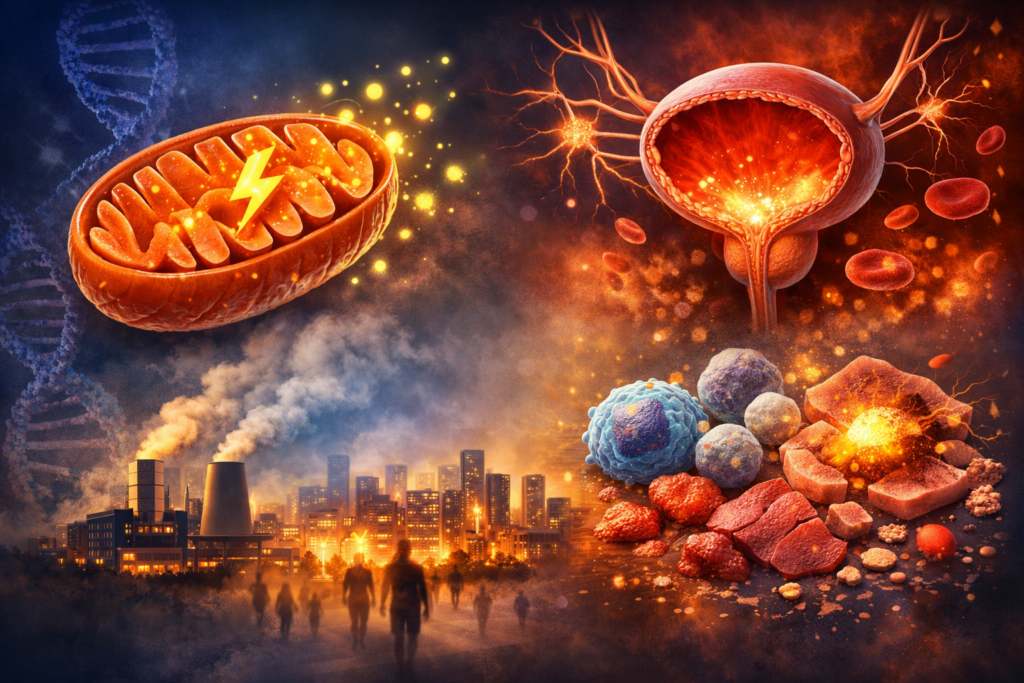
Introduction
Have you ever felt like you’re doing everything right… but your bladder symptoms just won’t improve?
You’ve changed your diet.
You’ve tried supplements.
Maybe you’ve even worked with multiple providers.
And yet—there it is.
The urgency. The discomfort. The flares that seem to come out of nowhere.
It’s frustrating. Confusing. And honestly, exhausting.
So let me ask you a different question—one that most people aren’t asking:
What if your body simply doesn’t have enough energy to heal?
A Simpler Way to Understand What’s Happening
Let’s strip away the complexity for a moment.
Think of your body like a city.
- Your organs are the buildings
- Your systems are the roads and infrastructure
- And your cells? They’re the workers keeping everything running
Now imagine that this entire city runs on a single type of energy currency.
That currency is called ATP (adenosine triphosphate).
ATP is what powers everything your body does behind the scenes.
Every second of every day, your cells are using ATP to:
- Repair damage
- Reduce inflammation
- Maintain the protective lining of your bladder
- Keep your nerves functioning properly
No ATP? The city slows down. Systems break. Repairs don’t happen.
Why Energy Matters More Than You Think
Here’s where things start to click.
Most approaches to bladder pain focus on what’s irritating the bladder.
But very few ask:
Does your body have the energy to repair the damage?
Because healing isn’t passive.
It’s not something your body just does automatically.
Healing is active work. And work requires energy.
If your cells don’t have enough ATP, they simply can’t keep up.
When Energy Runs Low
When ATP levels drop, your body starts to fall behind in ways that aren’t always obvious at first.
At the cellular level:
- Repair processes slow down
- Inflammation becomes harder to control
- Tissue becomes more vulnerable
Now let’s bring this back to your bladder.
Your bladder lining is meant to act as a protective barrier.
It shields underlying tissue from irritation.
But if your body doesn’t have enough energy to maintain and repair that lining?
It can become:
- More sensitive
- More reactive
- More prone to ongoing irritation
And suddenly, symptoms that should resolve… don’t.
The Pain Loop No One Explains
There’s another piece to this puzzle—one that traps many patients in a cycle.
Your nerves.
When ATP is low:
- Nerves don’t regulate properly
- Pain signals become amplified
- Your system becomes more reactive
This means your body isn’t just struggling to heal—it’s also becoming more sensitive to discomfort.
So even small triggers can feel like big problems.
🔁 The Double Hit: Inflammation and Energy Loss
Now let’s layer in something almost all chronic bladder pain patients experience:
Inflammation.
Inflammation creates a double burden on your body:
- It increases energy demand
Your immune system needs ATP to respond and regulate inflammation.
- It reduces energy supply
Inflammation can damage mitochondria—the parts of your cells that produce ATP.
So now you have a problem:
👉 Your body needs more energy
👉 But it’s producing less energy
This is where many people get stuck.
Why You Feel “Stuck” in Your Healing
If this resonates with you, it’s not because you’re doing something wrong.
It’s because your body may be:
- Underpowered
- Overloaded
- And stuck in a cycle it can’t break on its own
You can follow the perfect diet.
Take the right supplements.
Avoid every trigger.
But if your cells don’t have the energy to repair and regulate?
Progress can feel slow… or nonexistent.
The Missing Link: Your Mitochondria
So where does ATP actually come from?
Inside your cells are tiny structures called mitochondria.
Think of them as your body’s power plants.
Their job is simple—but critical:
👉 Take nutrients from food
👉 Convert them into ATP (energy)
When mitochondria are working well, your body has the energy it needs to:
- Heal tissue
- Calm inflammation
- Regulate pain
But when they’re not?
Everything we just talked about starts to happen.
Why This Matters for Testing and Treatment
This is where things start to shift from frustration… to clarity.
Because now we’re not just asking:
“What’s wrong with my bladder?”
We’re asking:
“Is my body producing enough energy to heal?”
This is exactly what metabolomics testing helps uncover.
Instead of just looking for disease, it looks at:
- How your body is producing energy
- Whether your metabolism is under stress
- How well your mitochondria are functioning
It gives us a functional snapshot of what’s really happening beneath the surface.
A New Way to Look at Your Symptoms
Let’s zoom out for a second.
What if your symptoms aren’t just about irritation…
But about your body’s capacity to respond and repair?
What if your bladder isn’t the root problem—
But the place where the problem is showing up most clearly?
This shift in perspective changes everything.
Because now, instead of chasing symptoms…
We start supporting the systems that actually allow healing to happen.
The Big Picture (And Why It Matters)
Here’s the key takeaway I want you to hold onto as you continue reading:
👉 Healing requires energy.
And when energy (ATP) is low:
- Repair slows down
- Inflammation becomes harder to control
- Pain signals become more intense
- And symptoms persist
This creates a cycle that can feel incredibly frustrating—but also very explainable once you understand what’s happening.
In the next section, we’re going to break this down even further.
We’ll start with the foundation:
What ATP actually is, and why your body depends on it more than you think.
Because once you understand that…
Everything else starts to make sense.
Chapter 1: Understanding ATP — Your Body’s Energy Currency
Let’s start with the foundation—because once you understand this, everything else begins to click.
If your body were a business, ATP would be your operating budget.
No budget? Nothing runs.
Low budget? Everything slows down.
And that’s exactly what happens in the body.
1.1 What Is ATP (Adenosine Triphosphate)?
ATP is the primary form of energy your body uses at the cellular level.
Every single cell in your body depends on it.
Not occasionally.
Not just when you exercise.
Constantly.
Your body is always:
- Repairing tissue
- Regulating inflammation
- Sending nerve signals
- Maintaining protective barriers
And all of that requires ATP.
Here’s the important part most people don’t realize:
👉 Your body doesn’t store much ATP.
It has to make it continuously, second by second.
So if production drops—even slightly—your cells feel it immediately.
1.2 The “City and Energy” Analogy (Why It Works So Well)
Let’s bring this back to something intuitive.
Imagine your body as a city again.
- Power plants = mitochondria
- Electricity = ATP
- Buildings = organs
- Workers = cells
Now imagine the power grid starts failing.
What happens?
- Streetlights flicker
- Systems shut down
- Repairs get delayed
- Emergency services get overwhelmed
The city doesn’t collapse overnight—but it becomes inefficient, strained, and reactive.
That’s exactly what happens in your body when ATP is low.
Not a total shutdown…
But a slow, frustrating decline in function.
1.3 What Your Body Uses ATP For (Especially in Bladder Health)
Now let’s make this very real for bladder pain.
ATP isn’t abstract—it’s directly tied to the symptoms you feel.
Repairing the Bladder Lining
Your bladder lining is constantly exposed to irritation.
It relies on ATP to:
- Repair microscopic damage
- Maintain a strong protective barrier
- Prevent sensitivity to urine components
Low ATP?
Repair slows → irritation increases → symptoms persist.
Regulating Inflammation
Inflammation isn’t just something that “happens.”
Your body actively works to:
- Turn inflammation on when needed
- Turn it off when it’s no longer helpful
That regulation requires energy.
Low ATP means:
- Inflammation lingers longer
- Resolution becomes inefficient
Nerve Function and Pain Signals
Your nervous system is energy-dependent.
ATP helps:
- Stabilize nerve signaling
- Prevent over-firing of pain pathways
When ATP is low:
- Nerves become more reactive
- Pain signals amplify
- Sensitivity increases
Immune Balance
Your immune system is one of the most energy-demanding systems in your body.
It needs ATP to:
- Identify threats
- Respond appropriately
- Avoid overreacting
Low energy can lead to a system that is:
- Overactive (chronic inflammation)
- Or poorly regulated
1.4 Why Energy Demand Increases During Illness
Here’s something that often gets overlooked:
When your body is under stress…
it needs more energy, not less.
Think about what’s happening during chronic bladder symptoms:
- Tissue is irritated → needs repair
- Immune system is active → needs regulation
- Nerves are firing → need stabilization
All of that increases ATP demand.
So now your body is asking:
👉 “Can I keep up with this workload?”
If the answer is no, a gap forms.
And that gap is where symptoms live.
1.5 The Hidden Problem: Why No One Talks About Energy
Most patients are taught to focus on:
- Triggers
- Diet
- Medications
- Supplements
All of which can be helpful.
But here’s the missing question:
👉 Do your cells have the energy to respond to any of those interventions?
Because even the “right” treatment requires your body to:
- Process it
- Respond to it
- Use it to repair
And that all requires ATP.
🔑 The Shift That Changes Everything
This is where your understanding starts to deepen.
Instead of only asking:
“What is causing my symptoms?”
You begin asking:
👉 “Does my body have the capacity to heal?”
Because capacity = energy.
And energy = ATP.
Bringing It All Together
Let’s simplify this into one clear idea:
- ATP powers repair
- ATP regulates inflammation
- ATP stabilizes nerves
- ATP supports healing
So when ATP is low:
- Repair slows
- Inflammation lingers
- Pain increases
- Healing stalls
Not because your body isn’t trying…
But because it doesn’t have the resources.
And this leads us to the next critical piece:
👉 What actually happens when ATP levels drop—and why that creates the symptoms you’re experiencing.
Chapter 2: What Happens When ATP Levels Are Low
Now that you understand what ATP is, let’s talk about what actually happens when your body doesn’t have enough of it.
Because this is where things stop being theoretical…
and start explaining your symptoms.
Low ATP doesn’t show up on a standard lab test.
But its effects? You feel those every day.
2.1 The Cellular “Energy Crisis”
When ATP levels drop, your cells go into what we can think of as an energy crisis.
They have to prioritize.
Think of it like your phone on 5% battery:
- It dims the screen
- Closes background apps
- Slows performance
Your cells do something similar.
They shift into survival mode:
- Basic functions are maintained
- “Extra” tasks—like repair—get pushed aside
And that’s the first problem.
Because healing is not a basic function.
It’s an energy-demanding one.
2.2 Impaired Bladder Lining Repair
Let’s bring this directly to bladder health.
Your bladder lining is meant to protect deeper tissue from irritation.
But it’s not static—it requires constant maintenance.
That maintenance depends on ATP.
When energy is low:
- Micro-damage accumulates
- The protective barrier weakens
- Irritants penetrate more easily
And what does that feel like?
- Burning
- Urgency
- Increased sensitivity
Not because something new is happening…
but because your body can’t keep up with repair.
2.3 Nerve Sensitization and Pain Amplification
This is one of the most overlooked pieces.
Your nerves rely on ATP to regulate how signals are sent.
When ATP is sufficient:
- Signals are controlled
- Pain is proportional
When ATP is low:
- Signals become exaggerated
- Thresholds drop
- Sensitivity increases
This creates a situation where:
👉 Small triggers feel like big problems
👉 Normal sensations feel uncomfortable
It’s not “in your head.”
It’s energy-dependent nerve dysregulation.
2.4 Slowed Metabolism and Delayed Healing
Your metabolism isn’t just about burning calories.
It’s about:
- Producing energy
- Repairing tissue
- Maintaining balance
When ATP is low, everything slows down:
- Tissue repair takes longer
- Inflammation lingers
- Recovery from flares is delayed
This is why many patients say:
“It just takes me forever to bounce back.”
That’s not random.
That’s metabolism underpowered.
2.5 Why Symptoms Persist (Even When You’re Doing Everything Right)
This is the part that frustrates people the most.
You’re:
- Eating clean
- Avoiding triggers
- Taking recommended supplements
And yet…
👉 You’re not improving the way you expected.
Here’s why:
Most treatments assume your body has the energy to respond.
But if ATP is low:
- Nutrients aren’t utilized efficiently
- Repair processes don’t activate fully
- Inflammation doesn’t resolve properly
It’s like trying to renovate a house with no electricity.
You may have the materials…
But nothing gets done.
The Pattern You Might Recognize
When ATP is low, patients often experience:
- Persistent symptoms
- Slow or minimal progress
- Sensitivity to small triggers
- Cycles of improvement followed by setbacks
It can feel unpredictable.
But there’s actually a pattern:
👉 Low energy = low resilience
Your body becomes less able to:
- Adapt
- Recover
- Stabilize
🔑 The Core Insight
Let’s simplify this again:
When ATP is low:
- Cells can’t repair effectively
- The bladder lining becomes more vulnerable
- Nerves become more reactive
- Healing slows down
And that combination?
👉 Creates the perfect environment for chronic symptoms to continue.
A Different Way to Think About Your Symptoms
Instead of asking:
“Why do I keep flaring?”
Try asking:
“Does my body have the energy to prevent or recover from this flare?”
Because prevention and recovery both require ATP.
And now we’re ready to go one level deeper.
Because this raises the obvious next question:
Why is ATP low in the first place?
To answer that, we need to talk about the source of your energy:
Your mitochondria.
Chapter 3: Mitochondria — The Power Plants Behind Your Healing
By now, you understand something most patients are never told:
👉 Healing requires energy
👉 Energy comes from ATP
So the next logical question is:
Where does ATP actually come from?
The answer takes us inside your cells—to something small, but incredibly powerful:
Your mitochondria.
3.1 What Are Mitochondria?
Mitochondria are tiny structures inside almost every cell in your body.
Their job is simple:
👉 Convert nutrients (food) into usable energy (ATP)
That’s it.
But that one job is responsible for powering:
- Repair
- Immune balance
- Nerve regulation
- Tissue health
If ATP is your energy currency…
Then mitochondria are the factories printing that currency.
3.2 How Mitochondria Become Dysfunctional
Here’s where things start to go wrong.
Mitochondria are highly sensitive.
They don’t function well under stress.
And most chronic bladder pain patients have been under long-term internal stress—whether they realize it or not.
Common contributors include:
- Chronic inflammation
- Oxidative stress (cellular “wear and tear”)
- Toxins (environmental or internal)
- Infections (past or ongoing)
- Chronic psychological or physical stress
Over time, these factors can:
- Damage mitochondrial structure
- Reduce efficiency
- Decrease ATP production
So now your body isn’t just using more energy…
👉 It’s producing less of it.
3.3 The Link Between Mitochondrial Dysfunction and Bladder Pain
Let’s connect this directly to what you feel.
When mitochondria aren’t functioning well:
🔻 ATP production drops
→ Less energy for repair
→ Slower recovery
🔥 Inflammation increases
→ Mitochondrial damage can trigger inflammatory signals
→ Inflammation becomes harder to resolve
🧱 Tissue becomes more vulnerable
→ Bladder lining weakens
→ Sensitivity increases
So instead of a stable system…
You get one that is:
- Reactive
- Fragile
- Easily triggered
3.4 The Vicious Cycle: Damage → Less Energy → More Damage
This is the loop that keeps many patients stuck.
Let’s walk through it simply:
- Inflammation or stress damages mitochondria
- Mitochondria produce less ATP
- Low ATP slows repair and regulation
- Inflammation increases further
- More mitochondrial damage occurs
And the cycle repeats.
👉 Damage → less energy → more damage
This isn’t a willpower issue.
It’s a physiological loop.
3.5 Signs Your Mitochondria May Be Struggling
Mitochondrial dysfunction doesn’t show up as one obvious symptom.
Instead, it shows up as a pattern.
You might notice:
- Persistent fatigue (even if mild)
- Slow healing
- Sensitivity to foods or stress
- Chronic inflammation
- Pain that feels disproportionate to triggers
And of course:
👉 Bladder symptoms that don’t fully resolve
🔑 The Insight That Changes the Strategy
Most approaches focus on:
- Reducing irritation
- Calming symptoms
But if mitochondria are impaired, that’s only part of the picture.
Because now we understand:
👉 The issue isn’t just what’s happening to your bladder
👉 It’s how well your body can respond to it
Bringing It All Together
Let’s simplify the chain:
- Mitochondria make ATP
- ATP powers healing
- Healing maintains bladder health
So when mitochondria are struggling:
- ATP drops
- Repair slows
- Inflammation increases
- Symptoms persist
A Subtle but Powerful Shift
Instead of asking:
“Why is my bladder so sensitive?”
You begin asking:
“Are my mitochondria producing enough energy to support healing?”
Because that question opens the door to a completely different approach.
And that leads us to the next critical piece of the puzzle:
Chronic inflammation
Because it’s not just a symptom…
It’s one of the biggest drains on your energy system—and one of the main reasons mitochondrial dysfunction continues.
Chapter 4: Chronic Inflammation — The Energy Drain You Can’t See
By now, you can probably see the pattern forming:
- Your body needs energy (ATP) to heal
- Your mitochondria produce that energy
- When they struggle, everything slows down
But there’s one major factor we haven’t fully unpacked yet…
👉 Chronic inflammation
And this is where things really start to stack against you.
4.1 What Is Chronic Inflammation (In Simple Terms)?
Inflammation isn’t always bad.
In fact, it’s essential.
If you cut your finger or get an infection, inflammation helps your body:
- Protect
- Repair
- Heal
That’s acute inflammation—short-term and helpful.
But chronic inflammation is different.
It’s like your immune system gets stuck in the “on” position.
Instead of resolving, it lingers in the background.
Quiet. Persistent. Draining.
4.2 How Inflammation Increases Energy Demand
Here’s something most people never consider:
👉 Inflammation is expensive for your body.
Your immune system requires a huge amount of ATP to:
- Detect problems
- Send signals
- Activate defenses
- Regulate the response
Now imagine this system running all the time.
Even at a low level.
That means your body is constantly:
👉 Spending energy… just to maintain the inflammatory response
4.3 How Inflammation Damages Mitochondria
Now we add the second layer of the problem.
Inflammation doesn’t just use energy.
It also interferes with your ability to produce it.
Chronic inflammation can:
- Damage mitochondrial membranes
- Increase oxidative stress
- Reduce efficiency of ATP production
So now your body is dealing with:
- Higher energy demand
- Lower energy production
That’s a losing equation.
4.4 The Double Burden: High Demand + Low Supply
Let’s simplify this into one clear picture:
Your body is trying to:
- Fight inflammation
- Repair tissue
- Regulate nerves
But at the same time:
- It’s burning through ATP quickly
- And producing less ATP than it needs
This creates an energy deficit.
And that deficit shows up as:
- Slower healing
- Increased sensitivity
- Persistent symptoms
4.5 Why This Is So Common in Bladder Pain Patients
Chronic bladder symptoms don’t exist in isolation.
There’s often ongoing internal stress such as:
- Repeated irritation of the bladder lining
- Immune system activation
- Nervous system sensitization
All of these contribute to ongoing inflammation.
Even if it’s subtle.
Even if it’s not showing up clearly on standard tests.
So your body ends up in a state where:
👉 It’s constantly trying to manage inflammation
👉 But doesn’t have the energy to resolve it
The Cycle That Keeps You Stuck
Let’s connect everything:
- Inflammation increases
- Energy demand rises
- Mitochondria become stressed
- ATP production drops
- Repair slows
- Inflammation persists or worsens
And the cycle continues.
Why This Feels So Frustrating
This is why many patients feel like:
- “I’m doing everything right”
- “I get better… then flare again”
- “Nothing fully resolves”
Because the system underneath is:
👉 Out of balance
Not from lack of effort…
But from lack of energy.
The Key Insight
Here’s the shift that matters:
You can’t fully reduce inflammation
if your body doesn’t have the energy to regulate it.
And you can’t restore energy
if inflammation continues to damage your mitochondria.
So both need to be addressed—together.
A New Way to Think About Healing
Instead of focusing only on:
- “How do I reduce inflammation?”
You start asking:
“How do I reduce inflammation and restore my body’s energy capacity?”
Because that’s how you break the cycle.
And this is exactly where most conventional approaches fall short…
They don’t measure or address this deeper layer.
But there is a way to see what’s really happening beneath the surface.
In the next section, we’ll talk about:
👉 How metabolomics testing helps uncover your body’s energy and inflammation patterns—and how that changes everything.
Chapter 5: How Metabolomics Testing Changes the Game
Up to this point, you’ve learned something powerful:
- Healing requires energy
- Energy comes from ATP
- ATP depends on mitochondria
- And chronic inflammation disrupts the entire system
So now the question becomes:
👉 How do you actually measure all of this?
Because without data, you’re guessing.
And guessing is where most patients get stuck.
5.1 What Is Metabolomics Testing?
Metabolomics testing looks at the small molecules (metabolites) in your body that reflect how your metabolism is functioning in real time.
In simpler terms:
👉 It shows how well your body is actually working, not just what it looks like on the surface.
This is very different from standard labs.
Most conventional tests look for:
- Disease
- Structural abnormalities
- Major imbalances
But metabolomics looks at:
- Energy production
- Cellular stress
- Nutrient utilization
- Mitochondrial function
It answers the question:
👉 “Is your body functioning efficiently at the cellular level?”
5.2 What It Reveals About Your Body
This is where things get incredibly useful.
Metabolomics can give insight into:
ATP Production Capacity
- Are you producing enough energy?
- Is your system underpowered?
Mitochondrial Efficiency
- Are your “power plants” working properly?
- Or are they struggling under stress?
Inflammation and Oxidative Stress
- Is your body stuck in an inflammatory state?
- Is there ongoing cellular damage?
Metabolic Bottlenecks
- Are there points where your metabolism is slowing down?
- Are key pathways not functioning optimally?
Instead of guessing, you get a map.
5.3 Why Standard Testing Misses This
This is an important distinction.
You can have:
- “Normal” blood work
- No obvious disease
- And still feel terrible
Why?
Because standard testing often misses function.
It’s designed to detect:
- Disease states
- Severe abnormalities
Not:
- Subtle inefficiencies
- Energy deficits
- Early dysfunction
So patients are often told:
👉 “Everything looks normal”
When in reality:
👉 Nothing is functioning optimally
5.4 Personalized Treatment Based on Data
Once you understand what’s happening, everything becomes more targeted.
Instead of trying random approaches, you can focus on:
🥗 Nutritional Strategies
- Supporting energy production pathways
- Providing the right building blocks for ATP
Mitochondrial Support
- Targeting specific areas of dysfunction
- Improving efficiency and output
Anti-Inflammatory Approaches
- Reducing the energy drain
- Protecting mitochondria from further damage
This becomes a precision approach.
Not trial and error.
5.5 From Guessing to Targeted Healing
This is where the real shift happens.
You move from:
❌ “Let me try this and see if it works”
➡️ to
✅ “I know what my body needs, and I’m addressing it directly”
That’s a completely different experience.
It’s:
- More efficient
- More empowering
- And often more effective
Why This Matters So Much
If your symptoms are being driven by:
- Low ATP
- Mitochondrial dysfunction
- Chronic inflammation
Then you need a way to see and measure those things.
Otherwise, you’re treating symptoms without understanding the system underneath.
The Big Takeaway
Metabolomics testing helps answer the most important question:
👉 “Does my body have the energy and capacity to heal?”
Because once you know that…
You can finally stop guessing—and start rebuilding.
Bringing the Entire Picture Together
Let’s connect everything one last time:
- Mitochondria produce ATP
- ATP powers healing
- Inflammation increases energy demand
- Mitochondrial dysfunction reduces energy supply
👉 This creates a cycle that keeps symptoms going
Metabolomics testing helps you:
- Identify where the breakdown is happening
- Understand your body’s unique patterns
- Create a targeted plan to restore balance
A New Direction Forward
If you’ve been feeling stuck, this may be the missing piece.
Not another supplement.
Not another restriction.
But a deeper understanding of:
👉 How your body is functioning—and what it actually needs to heal
And that brings us to the final piece of this conversation…
Pulling everything together into a clear, empowering perspective you can move forward with.
Conclusion: A Simpler, Smarter Way to Understand Your Healing
Let’s take a step back and look at everything together—clearly and simply.
Because when you zoom out, a very different picture starts to emerge.
The Truth Most Patients Aren’t Told
If you’ve been dealing with chronic bladder pain, you’ve probably been led to believe:
- Something is irritating your bladder
- You need to avoid triggers
- You need to calm inflammation
And while those things matter…
They’re only part of the story.
What’s often missing is this:
👉 Your body needs energy to heal.
Not just the right supplements.
Not just the right diet.
Energy.
The Model That Changes Everything
Here’s the framework you now understand:
- Mitochondria produce energy
- ATP is that energy
- Your body uses ATP to repair, regulate, and heal
- Inflammation increases energy demand
- Mitochondrial dysfunction reduces energy supply
And when those don’t match?
👉 You get stuck.
Why Symptoms Keep Coming Back
This is the cycle many patients are unknowingly in:
- Your body is trying to repair
- But doesn’t have enough ATP
- So healing is incomplete
- Inflammation lingers
- Nerves stay sensitive
- Symptoms persist or return
It’s not random.
It’s not because you’re failing.
👉 It’s because your system is underpowered.
Reframing How You See Your Body
Instead of thinking:
“What’s wrong with me?”
Try shifting to:
👉 “What does my body need more of to function properly?”
Because your body is not broken.
It’s responding to its internal environment.
And if that environment is:
- Low in energy
- High in inflammation
- Straining mitochondrial function
Then your symptoms make sense.
The Most Important Shift
This is the moment where things can start to change.
Instead of chasing symptoms…
You start supporting capacity.
Capacity to:
- Repair
- Regulate inflammation
- Stabilize nerves
- Maintain healthy tissue
And capacity comes back to one thing:
👉 Energy (ATP)
Why Deeper Testing Matters
If you don’t measure what’s happening beneath the surface, you’re left guessing.
That’s why tools like metabolomics testing are so valuable.
They help answer:
- Are you producing enough energy?
- Are your mitochondria functioning efficiently?
- Is inflammation draining your system?
Because once you see that…
You can act with clarity.
From Frustration to Direction
Imagine the difference between:
“I’ve tried everything and nothing works”
vs.
“I understand what’s happening in my body—and I know what to support”
That shift alone can change how you approach your health.
Not with more overwhelm…
But with focus and intention.
Bringing It Back to You
If you’ve felt:
- Stuck
- Frustrated
- Confused by slow progress
There’s a good chance your body isn’t lacking effort.
👉 It’s lacking energy and support at the cellular level
And once you address that…
Everything else starts to work better.
A More Hopeful Perspective
This isn’t about adding more to your plate.
It’s about understanding what actually matters.
Because when you support:
- Mitochondria
- Energy production
- Inflammation balance
You’re not just managing symptoms.
👉 You’re creating the conditions for healing.
Final Takeaway
Let’s make this as clear and simple as possible:
👉 Low ATP = less energy for healing + more difficulty controlling inflammation
And that combination can:
- Worsen bladder sensitivity
- Slow recovery
- Keep you stuck in cycles
But the opposite is also true.
👉 When energy improves, healing becomes possible again.
If You Remember One Thing…
Let it be this:
Your body’s ability to heal is directly tied to its ability to produce and use energy.
Not perfectly.
Not instantly.
But consistently.
You’re not broken.
You’re working with a system that may be:
- Overloaded
- Underpowered
- And in need of the right kind of support
And once you start addressing that…
You’re no longer guessing.
You’re moving forward with understanding.
Ready to Finally Understand What’s Driving Your IC Symptoms?
If you’ve been told everything looks “normal” but you’re still struggling, it’s time to look deeper. The truth is, without the right testing, key drivers like gut dysfunction, histamine issues, and nervous system imbalances are often missed.
Instead of guessing, let’s get clear answers.
👉 Book a personalized consult and functional testing plan here:
https://drmandydcn.com/booking/