
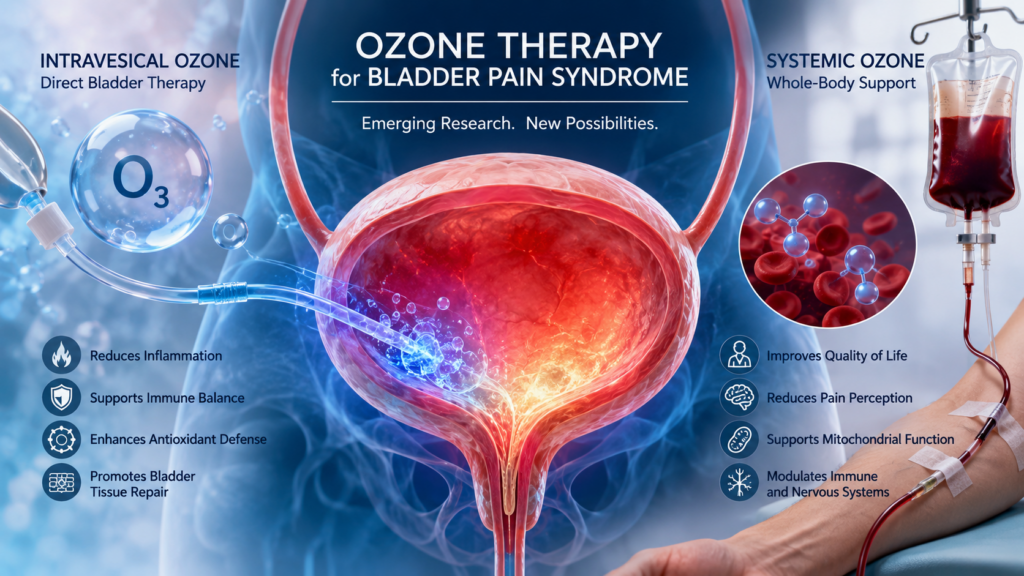
Ozone Therapy for Bladder Pain Syndrome: A Review of Emerging Research
Bladder Pain Syndrome/Interstitial Cystitis (IC/BPS) is a chronic condition characterized by pelvic pain, urinary urgency, frequency, and reduced quality of life. Conventional treatments often provide incomplete relief, leading researchers to investigate therapies that target inflammation, immune dysfunction, tissue repair, and nervous system regulation rather than infection alone. Two recent peer-reviewed studies explored the role of ozone therapy in IC/BPS using both intravesical (direct bladder) and systemic approaches.
Understanding the Shift in Bladder Pain Research
Emerging research suggests chronic bladder disorders are more complex than simple infections. Investigators now recognize that recurrent urinary symptoms may involve:
- Chronic inflammation
- Immune dysregulation
- Biofilms and intracellular bacteria
- Microbiome disruption
- Mast cell activation
- Oxidative stress
- Impaired bladder lining repair
- Neuroinflammation and pain sensitization
This broader systems-based perspective has encouraged interest in therapies that support tissue healing and immune balance rather than relying solely on antibiotics.
Intravesical Ozone Therapy Study (2023)
A 2023 peer-reviewed study by Marcos Vinicius Pires and colleagues evaluated intravesical ozone therapy in 16 women with severe IC/BPS who had failed conventional treatment. Ozone gas was instilled directly into the bladder twice weekly for three weeks.
Key Findings
At 180 days after treatment:
- Symptom scores improved by more than 90%
- Pain and urinary urgency significantly decreased
- 81% of patients reported no urgency or pain
- 75% reported resolution of urinary frequency
- Recurrence rates were low
- No major adverse effects were reported
Researchers proposed that ozone may help reduce inflammatory signaling, improve circulation, support antioxidant pathways, and promote bladder tissue repair.
Proposed Mechanisms
The study discussed several possible biological effects of ozone:
- Reduction in inflammatory cytokines and mast cell activity
- Improved redox balance through hormesis
- Enhanced oxygen delivery and microcirculation
- Support for bladder lining repair and epithelial healing
Importantly, the authors emphasized that the study was small, preliminary, and not placebo-controlled. Larger randomized trials are still needed before definitive conclusions can be made.
Systemic Ozone Therapy Study (2025)
A newer 2025 study by Marco Martinelli and colleagues explored systemic ozone therapy in 40 patients with IC/BPS using autohemotherapy, where blood is mixed with medical ozone and reinfused into the body.
Key Findings
Researchers reported statistically significant improvements in:
- Pain perception
- Physical functioning
- Emotional well-being
- Mental health
- Overall quality of life
Approximately 85% of participants experienced improvement, and no major adverse events were reported.
Why This Study Matters
Unlike intravesical ozone, systemic ozone therapy targets the body more broadly. The authors suggested IC/BPS may involve:
- Systemic inflammation
- Oxidative stress
- Neuroimmune dysfunction
- Altered pain processing
- Mitochondrial stress
This reflects a growing theory that the bladder may be the “target organ” of wider immune and nervous system dysregulation rather than the sole source of disease.
Shared Themes Across Both Studies
Both papers describe ozone therapy as potentially:
- Anti-inflammatory
- Immunomodulatory
- Supportive of antioxidant defenses
- Beneficial for circulation and oxygenation
- Helpful in regulating oxidative stress pathways
Rather than functioning as a simple antimicrobial treatment, ozone appears to influence multiple systems involved in chronic bladder pain. This may help explain why researchers are exploring ozone as a complementary therapy for difficult-to-treat IC/BPS patients.
Important Limitations
While the findings are promising, both studies had important limitations:
- Small sample sizes
- No placebo control groups
- Lack of randomization
- Short follow-up periods
- Reliance on subjective symptom questionnaires
Because of these limitations, ozone therapy cannot yet be considered a standard treatment for IC/BPS. More rigorous clinical trials are necessary to establish long-term safety, effectiveness, and ideal treatment protocols.
Final Thoughts
The emerging research on ozone therapy highlights an important evolution in how bladder pain conditions are understood. Instead of viewing IC/BPS solely as a localized bladder issue, newer studies suggest it may involve chronic inflammation, immune imbalance, oxidative stress, and nervous system dysregulation.
Both intravesical and systemic ozone therapy demonstrated encouraging early results in peer-reviewed studies, particularly for patients who had not responded to conventional therapies. While still experimental, ozone therapy may represent a promising future avenue for integrative bladder pain management as larger controlled studies continue to develop.
References
Pires MV, de Lima CJ, Carvalho HC, Moreira LH, Fernandes AB. Effectiveness of intravesical ozone in interstitial cystitis by the O’Leary-Sant symptom index. Int Urogynecol J. 2023;34(7):1437-1446.
Martinelli M, Glielmo A, Licci MR, Romanello D. Systemic ozone therapy improves the quality of life in patients with bladder pain syndrome. Bladder (San Franc). 2025;12(3):e21200054.